5 Awesome MinIO Alternatives
 Yulei Chen
MinIO is a high-performance, S3-compatible object storage system that has been a go-to choice for self-hosted storage for years. It's designed for AI/ML workloads, data lakes, and any application that needs an S3-compatible API without relying on AWS.
MinIO's pricing offers a free tier for single-node deployments, but production-grade distributed clusters require an Enterprise subscription starting at $24,000/year. If you want full control over your object storage without that price tag, you can self-host MinIO on Sliplane for just €9/month per server, with persistent storage, HTTPS, and zero server management.
But MinIO might not be the right fit for every use case. Maybe you need something lighter, cheaper at scale, or fully managed in the cloud. Here are 5 awesome alternatives worth considering.
1. SeaweedFS
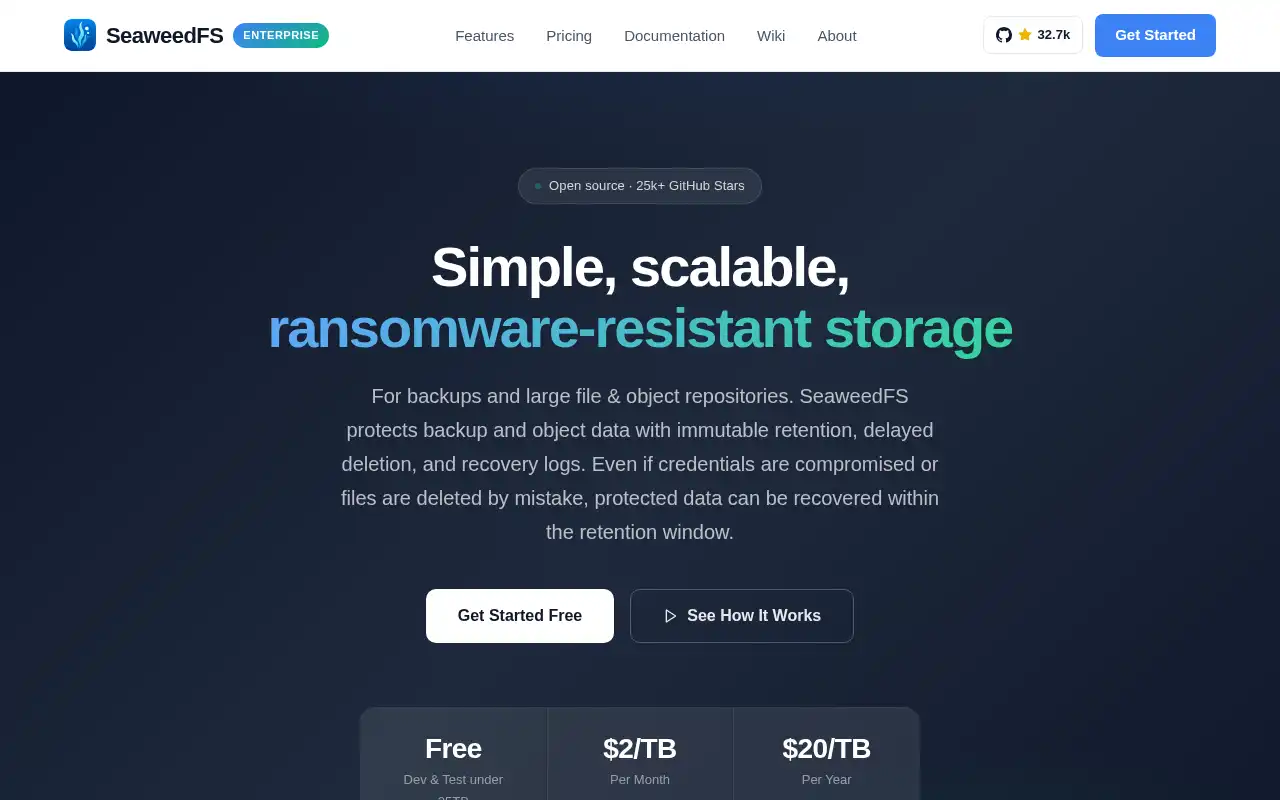
SeaweedFS is a distributed storage system built in Go that provides S3-compatible object storage, file system access, and even Iceberg table support. It's designed to handle billions of files with O(1) disk access, making it exceptionally fast for workloads with many small files.
- Features: S3-compatible API, POSIX filesystem via Filer, built-in Iceberg REST Catalog, erasure coding, cloud tiering (hot data local, warm data in cloud), point-in-time recovery, immutable retention, OIDC/SSO integration, and automatic data corruption detection.
- Why You Should Use It: If you're dealing with billions of small files (logs, metadata, snapshots), SeaweedFS outperforms MinIO significantly. Its architecture packs multiple files into volumes, so each lookup is a single disk seek regardless of total file count. It's also become the default MinIO replacement in projects like Kubeflow Pipelines and is battle-tested at petabyte scale.
- Why Not: Deployment is more complex than MinIO since you need to orchestrate multiple processes (Master, Volume, Filer, S3 Gateway). The enterprise features like multi-tenancy and encryption-at-rest are less mature than MinIO's offerings.
- Pricing: Free for development and testing under 25TB. Enterprise licensing is a flat $2/TB/month or $20/TB/year, with no API or egress fees. Self-hosting the open-source version (Apache 2.0) is completely free.
2. Garage
Garage is a lightweight, S3-compatible distributed object storage service written in Rust. It's built specifically for self-hosting scenarios, including edge deployments and geo-distributed setups across multiple locations.
- Features: S3-compatible API, geo-distributed replication by default, masterless architecture, single binary deployment, minimal resource footprint (runs on 512MB RAM), fault tolerance for unreliable networks, bucket policies, and web hosting capabilities.
- Why You Should Use It: If you need object storage on low-resource hardware like a Raspberry Pi, or want to replicate data across geographically distant nodes without complex configuration, Garage is purpose-built for that. It's the lightest self-hosted S3-compatible storage you can run, and the Rust implementation provides excellent memory safety and performance per watt.
- Why Not: Garage has a smaller community than SeaweedFS or Ceph, and the AGPL license can complicate commercial deployment. It lacks advanced features like storage tiering, detailed monitoring integrations, and the S3 API coverage isn't as broad as MinIO's.
- Pricing: Completely free and open-source (AGPL-3.0). You only pay for the hardware you run it on. Self-hosting on a VPS like Sliplane starts at €9/month.
3. Ceph (RADOS Gateway)
Ceph is an enterprise-grade distributed storage platform that provides object, block, and file storage from a single cluster. Through its RADOS Gateway (RGW), Ceph exposes an S3-compatible (and Swift-compatible) object storage interface that scales to petabytes.
- Features: S3 and OpenStack Swift APIs, stateless horizontally-scalable gateways, multi-pool storage tiering (SSD for metadata, HDD for data), erasure coding, multi-site replication, lifecycle policies, S3 Object Lock (WORM), bucket policies, S3 Select for in-place querying, and IAM integration.
- Why You Should Use It: If you need a storage platform that can do it all (object, block, and file storage) at petabyte scale with enterprise compliance features like WORM and SEC 17a-4 compliance, Ceph is unmatched. The stateless RGW architecture means you can scale object storage access linearly by adding more gateway instances behind a load balancer.
- Why Not: Ceph is resource-hungry, requiring at least 4GB RAM per daemon. Operational complexity is significantly higher than MinIO or SeaweedFS. It's overkill for most small-to-medium deployments and has a steep learning curve.
- Pricing: Ceph is free and open-source. Commercial support is available through Red Hat Ceph Storage and IBM Storage Ceph, with pricing based on cluster size and support tier (contact sales for quotes). Self-hosting is free but requires significant hardware resources.
4. Cloudflare R2
Cloudflare R2 is a fully managed, S3-compatible object storage service with one killer feature: zero egress fees. If your workload involves serving a lot of data to users, R2 can save you a fortune compared to AWS S3 or other cloud providers.
- Features: S3-compatible API, zero egress fees, 10GB free storage tier, Infrequent Access storage class, progressive migration (Super Slurper), native Workers API integration, R2 Data Catalog (managed Iceberg), global CDN delivery via 330+ data centers, and automatic data durability.
- Why You Should Use It: If you're spending too much on egress fees with AWS S3 or similar providers, R2 is a no-brainer. Content delivery, AI inference pipelines, and SaaS applications that serve assets to users benefit enormously from zero egress costs. The progressive migration feature lets you switch from S3 without downtime by pulling objects on demand.
- Why Not: R2 is a managed cloud service, so you don't own the infrastructure. Storage costs ($0.015/GB) are higher than some competitors like Backblaze B2. There's no self-hosting option, and you're locked into Cloudflare's ecosystem. Advanced features like lifecycle policies are more limited than AWS S3.
- Pricing: Free tier includes 10GB storage, 1M Class A operations, and 10M Class B operations per month. Standard storage is $0.015/GB/month, Infrequent Access is $0.01/GB/month. Class A operations (writes) cost $4.50/million, Class B (reads) $0.36/million. Zero egress fees.
5. Storj
Storj is a decentralized cloud storage platform that distributes your data across a global network of independent nodes. It's S3-compatible, offers enterprise-grade durability (11 nines), and claims to reduce cloud storage costs by up to 80% compared to traditional providers.
- Features: S3-compatible API, decentralized architecture across 30,000+ nodes, 99.999999999% durability via erasure coding, end-to-end encryption by default, multi-region redundancy without extra configuration, Object Mount for local filesystem access, and native integrations with tools like Veeam and Rclone.
- Why You Should Use It: If you want cloud-grade durability and global distribution without running any infrastructure yourself, and you care about data sovereignty and encryption, Storj delivers. The decentralized model means no single point of failure and inherent geographic redundancy. Storage and egress are both priced at $7/TB, which is competitive with major cloud providers.
- Why Not: Storj's minimum monthly fee is increasing to $50 starting July 2026, which makes it expensive for small workloads. Performance can be less predictable than centralized storage since data is distributed across independent nodes. The decentralized model also means you're trusting a network of third-party operators with your (encrypted) data.
- Pricing: $7/TB for storage, $7/TB for egress. Minimum monthly fee of $50 (effective July 2026). Free trial available. Accounts paying with STORJ token are exempt from the minimum fee. Each paid Teams license ($29/month) includes 500GB of storage.
Conclusion
| Tool | Best For | Ease of Setup | Focus | Cloud Pricing |
|---|---|---|---|---|
| MinIO | S3-compatible self-hosted storage | Easy | High-performance object storage | Free single-node, Enterprise from $24k/yr |
| SeaweedFS | Billions of small files, data lakes | Moderate | Distributed storage with Iceberg | Free <25TB, $2/TB/mo Enterprise |
| Garage | Edge, low-resource, geo-distributed | Easy | Lightweight self-hosted S3 | Free (AGPL), self-host only |
| Ceph | Petabyte-scale enterprise storage | Complex | Multi-protocol (object/block/file) | Free open-source, paid support via Red Hat/IBM |
| Cloudflare R2 | Egress-heavy workloads, CDN | Very Easy | Managed S3 with zero egress | Free 10GB, $0.015/GB/mo |
| Storj | Decentralized, encrypted storage | Easy | Global distributed cloud | $7/TB, $50/mo minimum |
Each alternative fills a different gap: SeaweedFS for high-throughput workloads with billions of files, Garage for lightweight edge deployments, Ceph for enterprise-scale multi-protocol storage, Cloudflare R2 for managed storage without egress fees, and Storj for decentralized global storage with built-in encryption.
MinIO remains a solid choice for straightforward self-hosted S3-compatible storage, especially for single-node setups. But if your needs lean toward lower resource usage, managed cloud, or petabyte-scale enterprise features, one of these alternatives might serve you better.
If you're looking for affordable object storage options, check out our guide on 5 cheap object storage providers or learn how to get started with Hetzner Object Storage.